
 GRAIS
GRAIS
Source Code
Heads up: FAIR artefacts are being published in stages. Items marked “Coming soon” will appear in the next updates; “External” links point to project-controlled sources (e.g., GitHub or a data catalogue) when appropriate.
GRAIS Core Repository
Planned contents
- Simulation scripts for GRB generation using Fermitools
- Simulation scripts for GRB generation using GenAI models
- Utilities for dataset labelling
- End-to-end pipeline for GRB detection (preprocessing, scanning, and classification modules)
- Documentation and usage tutorials
Datasets
GRAIS datasets are grouped into two categories: GRB Simulations (A) and
Candidate GRBs (B).
Each dataset comes with a minimal open sample (CSV, 5 rows) for quick inspection and the full files in compact formats (e.g. .parquet) for research use.
FAIR artefacts (metadata, README, provenance, dictionary, and citation) are being added incrementally and are clearly marked below.
Need the full files? See “Licence & Citation” for terms and preferred citation, then follow the repository or the contact instructions where noted.
A. GRB Simulations
A1. GRB Simulations via gtobssim
Overview: physically grounded GRB simulations generated with Fermitools’ gtobssim, reproducing instrument response, background conditions, and realistic photon-level behaviour. The simulated GRBs numbered 1 to 500 have fluxes of photons between 0.07 and 0.1 m⁻² s⁻¹; the simulated GRBs numbered 501 to 2500 have retaled fluxes between 0.1 and 1 m⁻² s⁻¹; the simulated GRBs numbered 2501 to 9500 have fluxes of photons between 1 and 10 m⁻² s⁻¹; the simulated GRBs numbered 9501 to 10000 have fluxes between 10 and 50 m⁻² s⁻¹. You'll find a small part of dataset.
Intended use: designed for validating the pipeline against fully controlled, physics-accurate scenarios and for training of the anomaly detection pipeline.
Primary files
Last updated: 2025-11-30
Preview (CSV)
First 5 rows from a tiny sample file for curves; the full dataset is available via the zip download above.
FAIR artefacts (status)
We’re progressively adding the artefacts below; items marked “Coming soon” will appear in the next releases.
- Metadata record· metadata.json
- README· README.md
- Data dictionary· dictionary.csv
- Provenance & methods· provenance.md
- Licensing LICENCE
A2. GRB Simulations via GenAI model
Overview: synthetic GRBs produced through a generative AI model that captures diverse temporal, spectral, and morphological patterns beyond those present in standard simulations.
Intended use: case study for a new GenAI tool which aims at providing a validate alternative for the simulation of the GRBs without Fermitools.
Primary files
Last updated:
Preview (CSV)
First 5 rows from a tiny sample file for curves; the full dataset is available via the .csv download above.
FAIR artefacts (status)
We’re progressively adding the artefacts below; items marked “Coming soon” will appear in the next releases.
- Metadata record · metadata.json
- README · README.md
- Data dictionary · dictionary.csv
- Provenance & methods · provenance.md
- Licensing LICENCE
B. Candidate GRBs
B1. Candidate GRBs
Overview: a curated collection of transient candidates identified by the GRAIS anomaly-detection pipeline in the LAT photon data.
Intended use: serves as a resource for scientific inspection, follow-up analyses, and future catalogue development by the high-energy astrophysics community.
Primary files
Last updated:
Preview (CSV)
First 5 rows from a tiny sample file for curves; the full dataset is available via the .csv download above.
FAIR artefacts (status)
We’re progressively adding the artefacts below; items marked “Coming soon” will appear in the next releases.
- Metadata record· metadata.json
- README · README.md
- Data dictionary · dictionary.csv
- Provenance & methods · provenance.md
- Licensing & citation LICENSE
Diagrams & Technical Notes
-
Fermitools Pipeline (v1)
Fermitools pipeline for simulation and labelling.
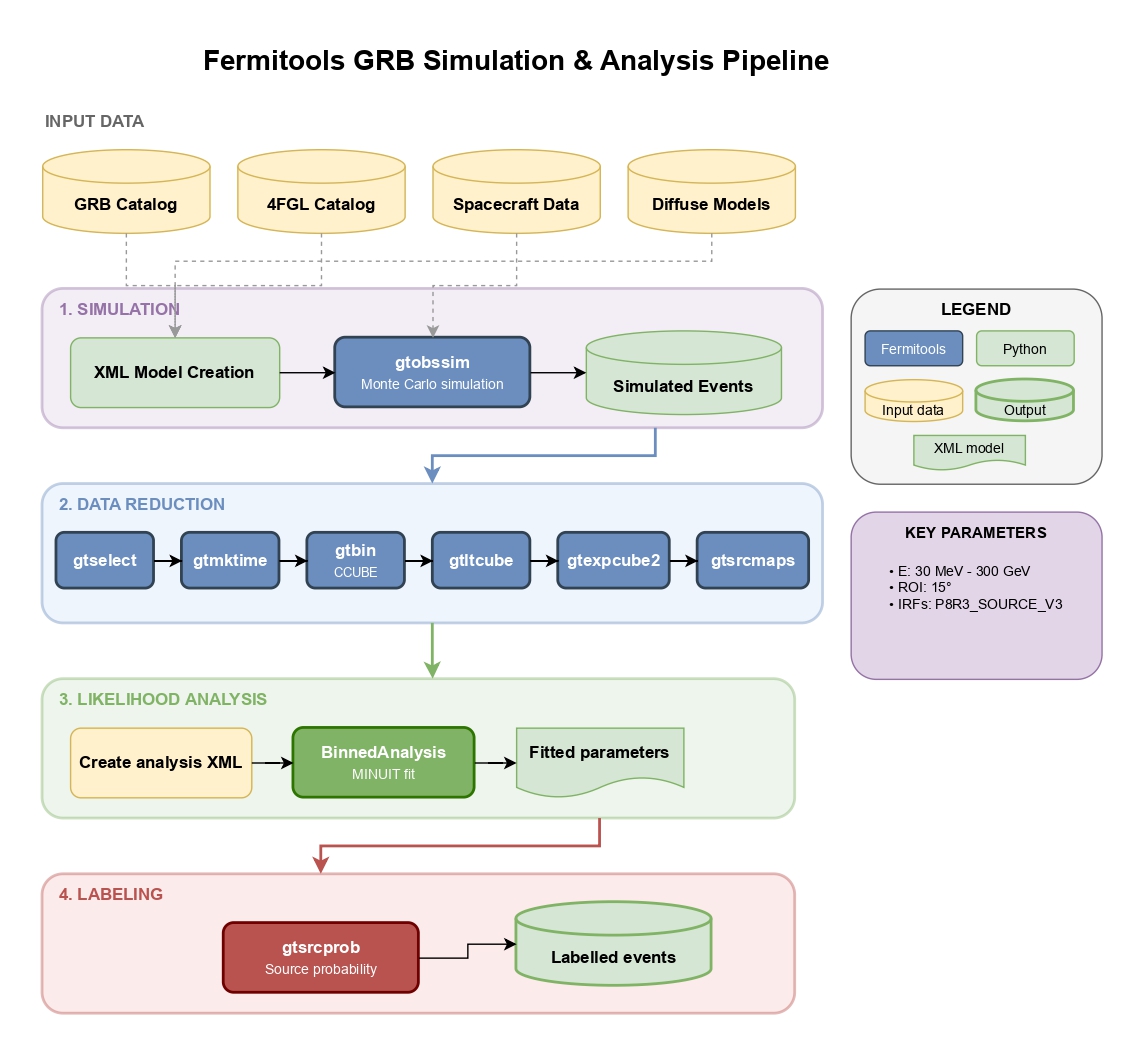
Visual summaries of the images. Click an image to download the full-resolution version.
-
GenAI architecture (v1)
Scheme of the architecture of the GenAI model.
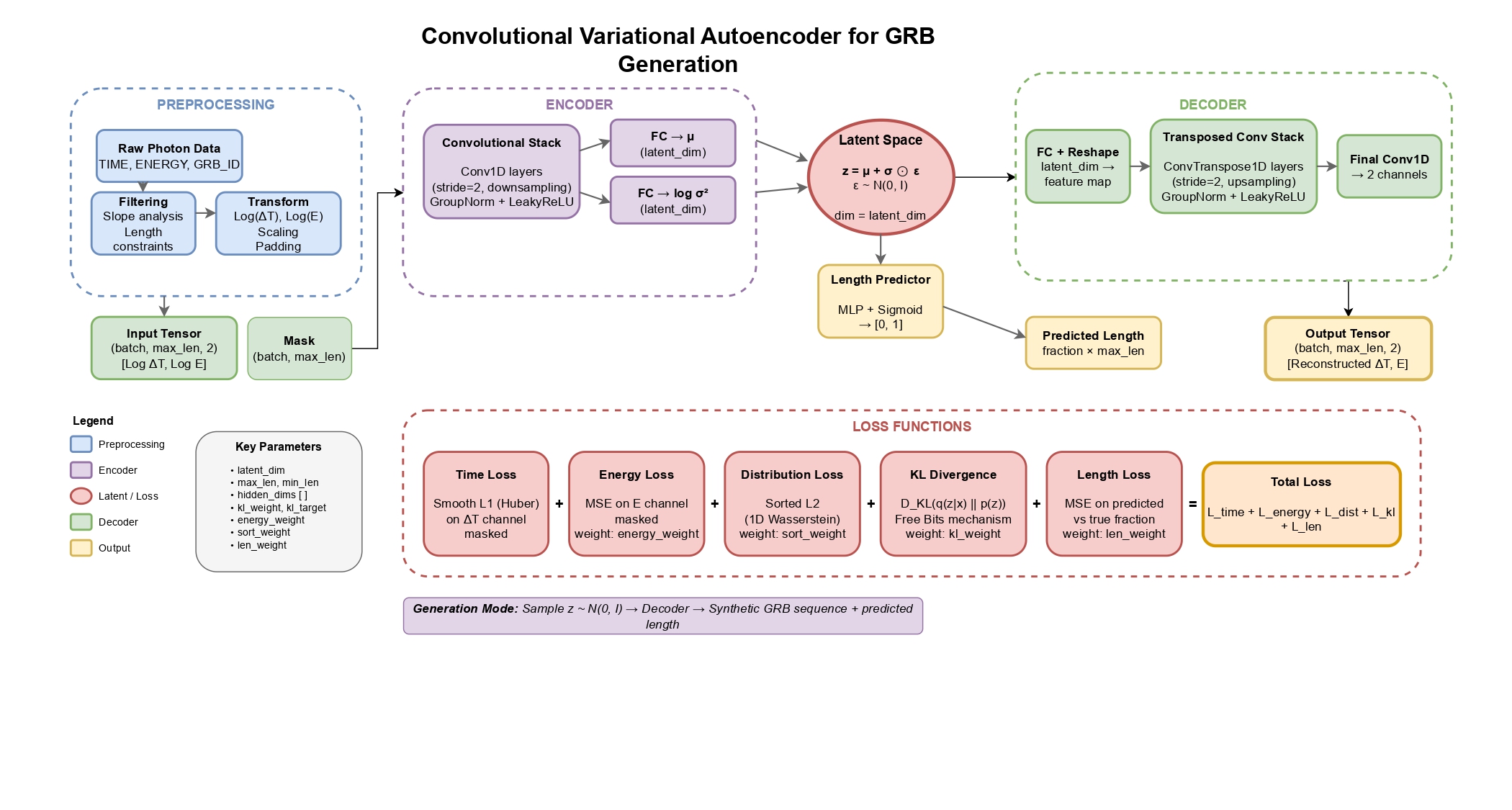
Visual summaries of the images. Click an image to download the full-resolution version.
-
Anomaly Detection architecture (v1)
Scheme of the architecture of the Anomaly Detection model.
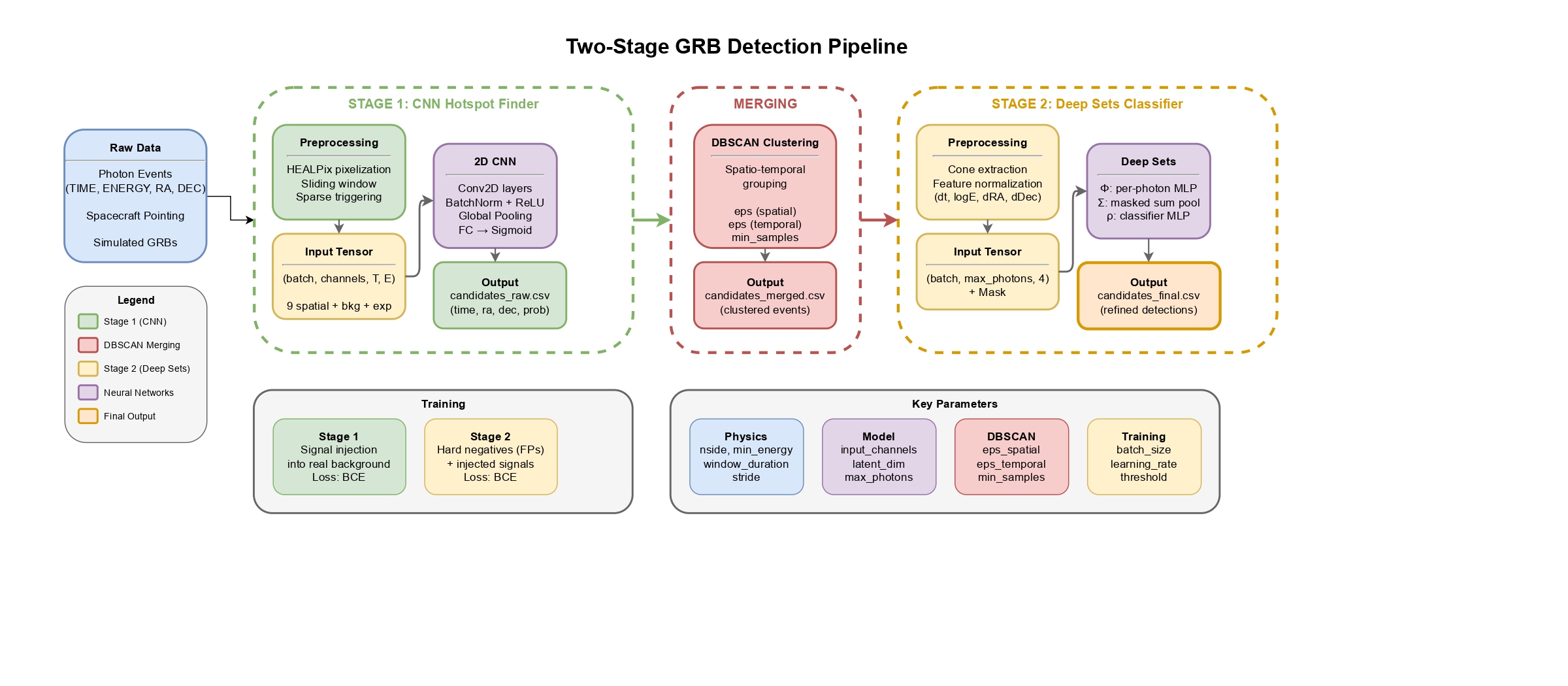
Visual summaries of the images. Click an image to download the full-resolution version.
Licence & Citation
To support ethical reuse and proper attribution, GRAIS provides default licensing and citation templates for datasets and software.
Important: if a dataset or repository includes its own LICENSE, citation.txt, or DOI,
that local file overrides the defaults below. Always prefer the per-item files when present.
If you adapt the datasets or code, indicate changes and, where practical, link back to this hub so others can find the original materials.
Datasets — Licence & how to cite
Licence (default): Creative Commons Attribution 4.0 International (CC BY 4.0). You must provide appropriate credit and indicate if changes were made. Read the licence.
Recommended dataset citation (plain text)
GRAIS Project (2025). GRAIS - Simulation and Anomaly Detection, v0.1.
        Koexai. URL: https://grais.koexai.com/resources/ Licence: CC BY 4.0.
Dataset BibTeX (template)
@dataset{grais_datasets_v0_1_2025,
                    author  = {Koexai Srl},
                    title   = {GRAIS — Simulation and Anomaly Detection},
                    year    = {2025},
                    version = {0.1},
                    url     = {https://grais.koexai.com/resources/},
                    license = {CC BY 4.0}
                  }
Software — Licence & how to cite
Licence (intended): MIT Licence (to be confirmed in the repository).
A copy of the licence will be included as LICENSE in the repo.
About MIT.
Recommended software citation (plain text)
GRAIS Project (2025). GRAIS Core (v0.1) — Generative models and characterisation tools.
        Source code. URL: https://grais.koexai.com/resources/ Licence: MIT.
Software BibTeX (template)
@software{grais_core_v0_1_2025,
                    author  = {Koexai Srl},
                    title   = {GRAIS Core},
                    year    = {2025},
                    version = {0.1},
                    url     = {https://grais.koexai.com/resources/},
                    license = {MIT},
                    note    = {Replace with repository URL and tag when public}
                  }